


liquefaction cooking tank
A liquefaction cooking tank is an industrial vessel designed to heat, mix, and convert raw starch-based materials into a uniform slurry through controlled cooking. It is widely used in food processing, beverage production, bio-fermentation, and other manufacturing fields where starch liquefaction is required before further processing. The tank plays a critical role in improving material consistency, enhancing enzymatic reaction efficiency, and ensuring stable product quality.The main function of a liquefaction cooking tank is to gelatinize starch and reduce the viscosity of the mixture under high temperature. During operation, raw materials such as corn starch, rice flour, cassava starch, or other carbohydrate-rich ingredients are fed into the tank with water and auxiliary additives. The mixture is then stirred continuously while being heated to a specified temperature. This process breaks down large starch molecules into smaller chains, making the slurry easier to handle in later stages. Uniform heating and agitation are essential to avoid burning, sedimentation, or uneven cooking.A typical liquefaction cooking tank is constructed from food-grade stainless steel to ensure corrosion resistance, hygiene, and durability. The interior surface is usually polished to prevent material residue and simplify cleaning. The tank may be equipped with a jacketed heating system, steam inlet, thermal insulation, temperature sensors, pressure control devices, and a mechanical agitator. These components work together to maintain precise processing conditions. Depending on the application, the tank can be designed as a batch unit or integrated into a continuous production line.Temperature control is one of the most important aspects of the liquefaction process. If the temperature is too low, starch gelatinization may be incomplete, leading to poor conversion efficiency. If the temperature is too high, the material may degrade, affecting flavor, color, and functional properties. For this reason, accurate monitoring and automated control systems are often used. The agitation system also helps distribute heat evenly throughout the tank, ensuring that every part of the slurry is properly cooked.Another advantage of the liquefaction cooking tank is its ability to improve production efficiency. By converting thick raw slurry into a more fluid and stable liquid, it allows downstream equipment such as filters, fermenters, or reactors to operate more smoothly. This reduces blockages, shortens processing time, and increases overall output. In food production, it also helps create a better texture and more consistent final product.The design of the tank may vary according to capacity, heating method, and production requirements. Small units are suitable for laboratory or pilot-scale testing, while large industrial tanks are used for mass production. Some systems include automated feeding, discharge, cleaning, and control functions to reduce labor costs and improve hygiene.In summary, a liquefaction cooking tank is an essential piece of processing equipment for converting starch-rich materials into a cooked, homogeneous, and easily processed slurry. Its reliable heating, mixing, and temperature control functions make it valuable in many industries. With proper design and operation, it contributes to product quality, process stability, and production efficiency.
製品
カテゴリー:
Liquefaction Cooking Tank
-
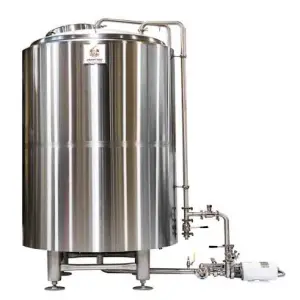
Cold Liquor Tank for Brewery
彼らの分類: Cold & Hot Water Tanksビュー: 212番号:解放時間: 2026-08-27 16:41:35Cold Liquor Tank for Brewery The Aelt cold-liquor tank is designed to store cold water for the brewing process, commonly referred to as “cold liquor”.Our cold-liquor tanks are constructed from SUS304 or 316L stainless steel and fitted with insulated dimple jackets to maintain low water temperature. These water tanks can be connected to a refrigeration system to keep the water at a consistently low temperature. PRODUCT DESCRIPTIONDescriptionA cold water tank, also referred to as a cold liquor tank in breweries, is a buffer tank for storing cold water. After wort boilin...
ニュース
カテゴリー:
検索結果はありません!
ケース
カテゴリー:
検索結果はありません!
ビデオ
カテゴリー:
検索結果はありません!
ダウンロード
カテゴリー:
検索結果はありません!
採用
カテゴリー:
検索結果はありません!
おすすめ商品
検索結果はありません!



 電話
電話